Duniya Giles Gambo
Art exhibitions mostly come with fancy titles or themes, but beyond such fancy brandings are insightful messages into the mindsets that created such works. Incidentally, people hardly reflect on such themes, in relation to the works on display. It is the intention of this article, to attempt a symbiotic relationship of the works in this exhibition catalogue with the theme of the exhibition cum catalogue.
Consequently, between “lock and longing” exemplifies the recent trajectory of two contemporary Nigerian Artists; one is conceptually interrogating locks and the other longings, inspired by children’s aspirations. In thatrespect, Lasisi Lamidi, interrogates varied forms and nature of locks, either of the traditional padlocks on doors or even windows, or to be locked inside a house or indeed, outside of it, additionally are locked-up habits, among several other situations, but just to mention a few. Some of these lock types are exhibited by Lamidi through works such as, “Trials and Trepidation”; Key to Freedom” as well as, “Chains and Padlocks”. This account for the “lock” in the theme of this exhibition. On his part, Harrison Idahosa reflects on the nature of Children’s longings, such that they become the longings of most Nigerians, in terms of overcoming the harsh socio-economic, political and cultural environment. This is particularly geared towards the youths. These conditions are creatively reflected in works such as “Ground Rules”; “Unapologetic” and “CTRL Shift”, just to mention but three. Similarly, this accounts for the longing in the theme. Consequently, accounting for the theme “Between Lock and Longing”
Together, these two Artists present their creative intellectualisation of the Nigerian space, through conceptualised ideations of same. In doing that, they dug into metaphors, satire and sometimes irony, to be able to adequately and effectively communicate their subjective perspectives of Nigeria. For instance; “Ground Rules” is reflective of the current Nigerian environment. An environment filled with a rough economy, a failed infrastructure, and a collapsing system.
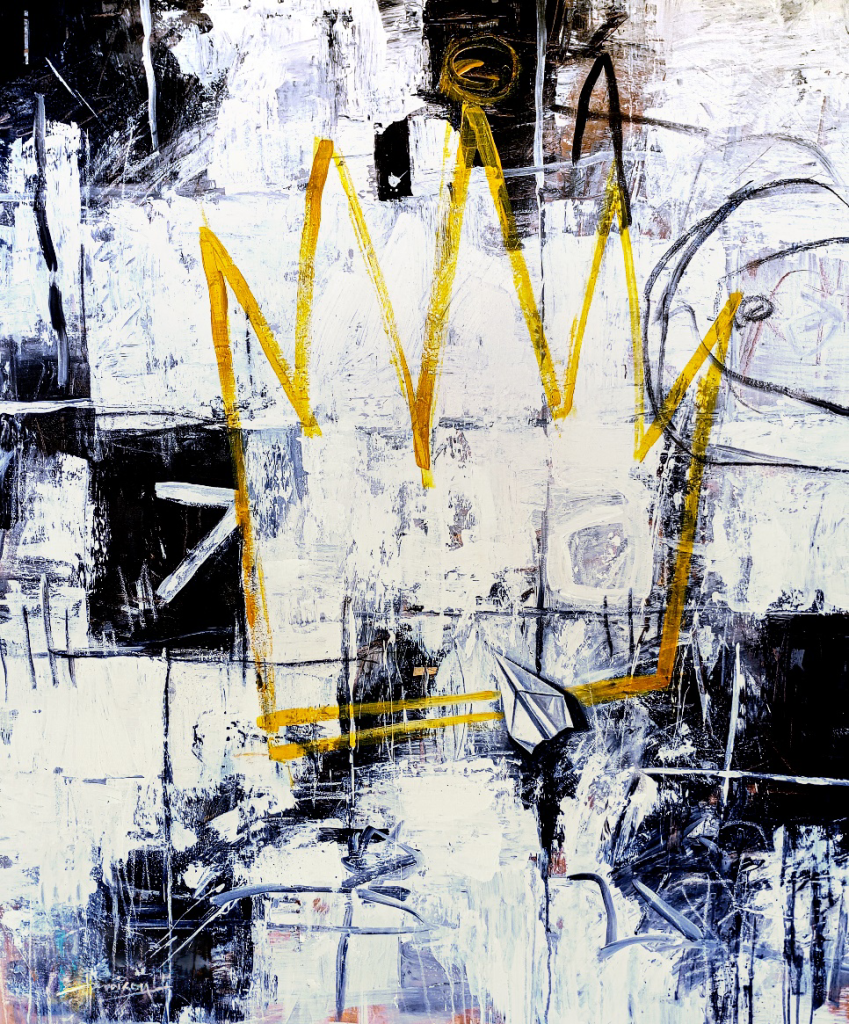
Ground Rules , Mixed media on canvas 147 x 172cm. 2025
Hence, an environment that requires contemplative patience, measured persistence and intellectual manoeuvre. It is therefore, not surprising that the Artist brought together a cacophony of materials, forms, effects particularly with colours, as well as lines and techniques, in order to metaphorically present the Nigerian reality in this painting. According to Idahosa, “the painting recalls chinkus, a game that demanded patience and persistence”. Thus, different things are symbolic of various experiences or circumstances within the context of present day Nigerian environment. These are explained by the Artists thus, “the Crown marks triumph, while the paper plane recalls the fragile yet powerful drive of imagination”. All these, are embodiments of the persistent struggles that Nigerians go through and their aspirations for a better socio-economic, political and cultural environment.
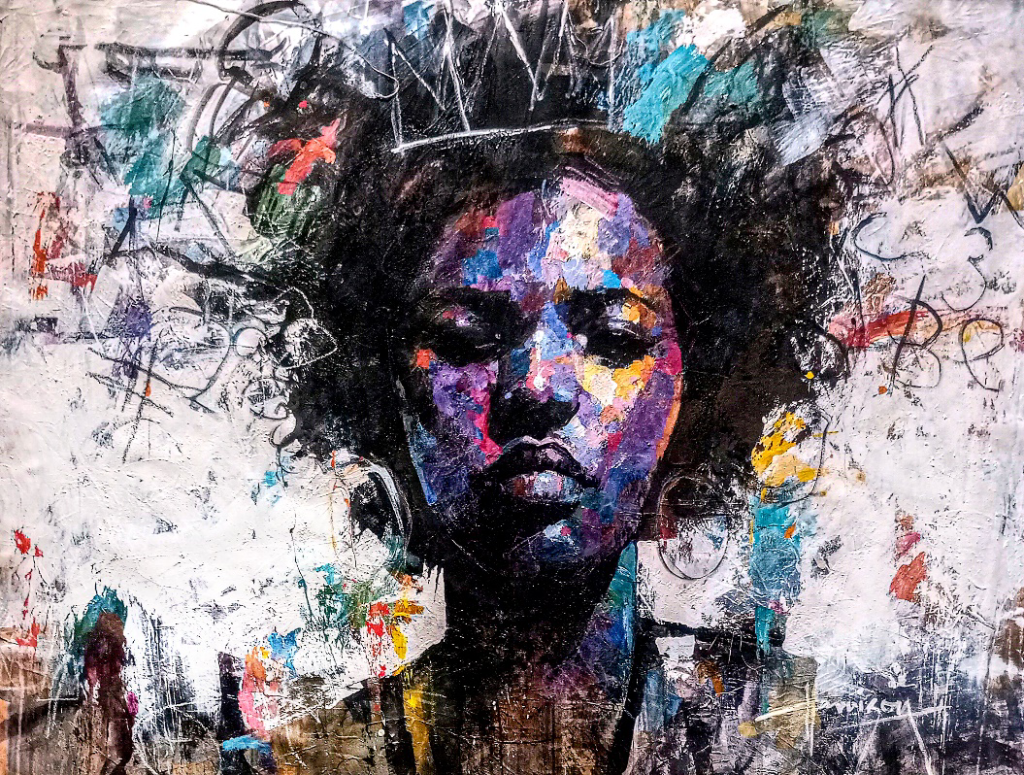
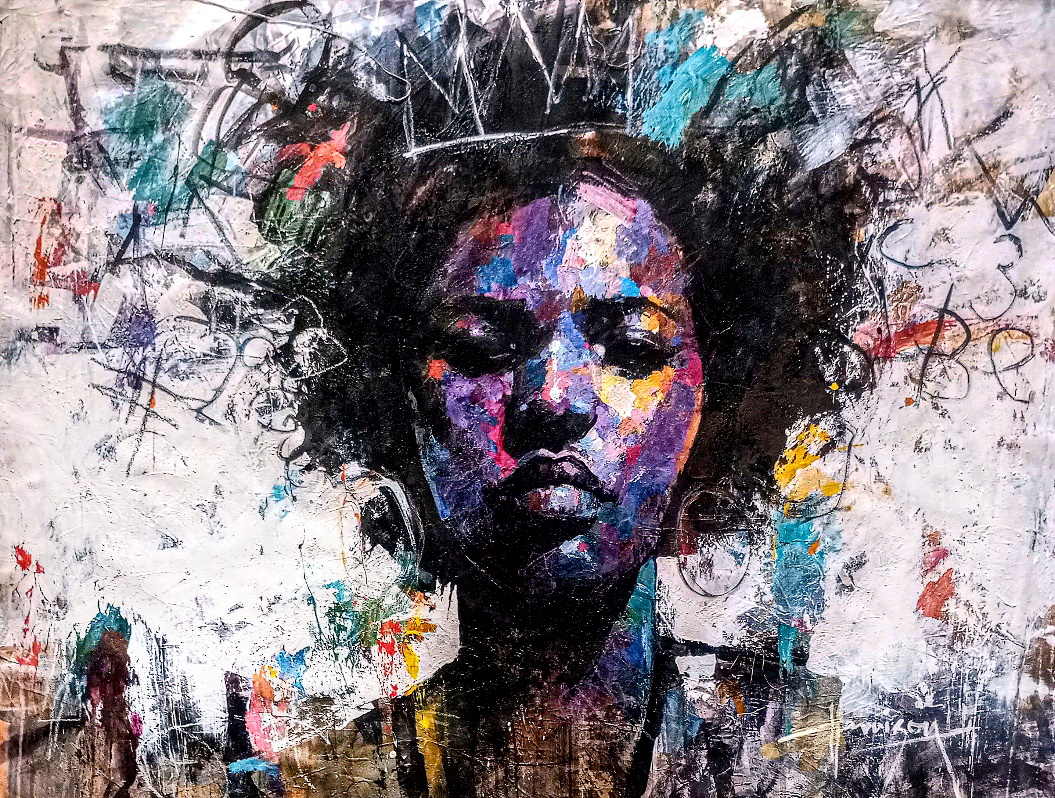
Unapologetic, Medium: Mixed media on canvas, Size: 154 x 122 cm Year: 2025
Also, Unapologetic portrays a young lady who appears to be in her early twenties, her face painted in shades of purple, blue and orange. Her gaze is firm and confident, capturing a sense of strength that inspires the title of the painting. The artist uses dark tones of brown, contrasted with touches of white, to render her clothing and body, giving the work depth and visual balance. Her hair appears somehow rough and loosely styled, imbued with dynamic lines of varying types. Resting on the figures head, is a crown treated with simple Minimalist zig-zag lines, that symbolises inner royalty. The background is largely white, with soft touches of blue, yellow and red, adding energy to the scene. Across the surface are scattered hashtags, symbolising different things
According to the artist, “Unapologetic reflects on the generational hurdles faced by Gen Z in Africa, the figure’s face conveys emotional tension, brought to life, through her facial expression”. The Gen Z generation appears to be unapologetic in almost all they do. Thus, Unapologetic mirrors the mindset and social reality of Gen Z in Africa, a generation marked by boldness, awareness and a refusal to be silenced. The young woman’s assertive expression reflects the spirit of Gen Z activism, especially in Nigeria, where youths have used digital platforms to challenge injustice and demand accountability. Her slightly unkempt hair and vibrant face, communicate both vulnerability and power, revealing a generation in a fragile socio-economic, political cultural and religious environment, yet bold.
The crown atop her head can be alluded to the themes of dignity and self-worth. For many Gen Z individuals, identity and self-expression are acts of resistance and deviance. The main ways to affirm their place in a society that often undervalues youth voices. The hashtags further connect the painting to the digital era, where social media serves as both a stage and a tool for change. Movements like #EndSARS gave Gen Z a collective voice, making online spaces platforms for protest and empowerment. Hence, Unapologetic stands as a visual statement of boldness, identity, and resilience, despite the tough socio-economic, political, and cultural environment. Through its composition, colour and symbolism, the painting captures the energy of a generation that is unafraid to confront power and speak truth, unapologetically.
Similarly, Lasisi Lamidi’s “Trials and Trepidation” is an installation art that conceptually captures the condition of the average Nigerian; disillusioned, hopeless, distressed and exploited by the systems, organs, organisations/institutions and governments that should protect, as well as, give hope to them. Despite all these, most individuals are resilient, courageous and enduring, symbolically represented in the different frames or “locked spaces”. For example, you find symbolic persons that are hanging by the tread, those that are floating on nothingness, those who are leaning on fragile systems and those whose lifes are completely upside-down, yet striving to push on. According to Lamidi, “the various frames in the artwork represent families, navigating different circumstances, underscoring the daily struggles they face, to overcome the delimma they are facing.
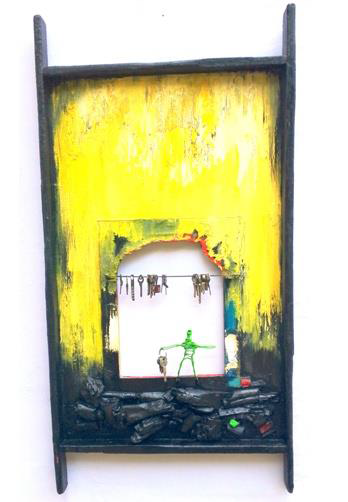
“Key of Freedom I” Minimalist Installation, Mixed Media, 2024,
In “Key to Freedom I” Lamidi also, presents a horizontal installation executed in the form of a door, a symbol of passage, on one hand and a locked frame, on the other. The work is dominated by yellow and black hues; the upper part is depicted with bright yellow, touched with white and light brown colours, while the lower half is painted with black clours, made up of wooden pieces of different shapes and sizes, carefully arranged together.At the center of the installation, lies an open space shaped like a small house, within which stands a figure with arms outstretched sideways, holding a bunch of keys in the left hand, perhaps to lock or unlock. Above the figure’s head, are more keys, hanging freely from a vertical line, almost like clothes on a line.
Key of Freedom I depicts the freedom humans have; God has given them the free will to make choices in life. Although humans have the freedom to make choices in life, all these choices have either positive or negative consequences. Again, it shows how delicate, the balance between freedom and responsibility is. The door form signifies transition, suggesting that life itself is made up of many thresholds and moments, when choices must be made. The use of colours in the installation is symbolic; the use of yellow is suggestive of enlightenment and divine guidance, while black, in the lower section, reflects the uncertainty and difficulty that often accompany decision-making. The contrast between both halves visually captures the moral and emotional duality of human freedom. The central figure, with open arms and keys in hand, represents humanity’s ability to choose from opening or closing doors that lead to different outcomes. The keys hanging above, suggest that options are always present, but freedom requires discernment. In essence, Key of Freedom I is a reflection on the human condition; it celebrates the right to choose, while warning that freedom, though beautiful, is never without consequence.
It is clear that Lasisi Lamidi and Harrison Idahosa are two distinct Artists, but with similar goals; a humanistic society. They are inspired by different experiences; Idahosa by the similitude of Children’s longings and Lamidi, by the locks that individually restrict or by those imposed by society. Thus, their desire is to positively create possibilities for both humanities longings and ways to unlock variegated locks that have held society down. It is therefore, not surprising that Lamidi found the “Ubuntu” philosophy useful, which according to him “emphasises the significance of communal solidarity, social welfare and ecological harmony in guiding development and integration”.
Idahosa on his part, stresses that in his art creation, ” each painting begins as an act of remembering and becomes a process of rewriting (painting). The layered surfaces mirror the complexities of emotional and historical experience, where beauty and struggle coexist”. Hence, one thing is obvious, this theme “Between Lock and Longing” speak beyond its seeming literary connotation, it demands our collective reflection on the contexts that inspired these two Artists, with a view to creating our own personalised understanding of the issues.