Faida Samuel
While growing up, we often heard about the Jos main market, popularly known as Terminus, and I looked forward to shopping there. Unfortunately, by the time I visited Jos in 2010, the market had already been destroyed by fire. I never got to experience the busy market as it was described to me, and was left only with my imagination. Jos’ main market was once a busy center of commerce and was one of the largest markets in West Africa. Its significance extended beyond mere commerce; it was a lively place of the region’s diversity, a meeting point for traders, artisans, and consumers from across Nigeria and beyond. However, this iconic market was tragically ravaged by fire on 12th February 2002, an event that not only destroyed the physical structure but also shattered the lives and livelihoods of countless individuals. In Delineating the Jos Burnt Market exhibition, Dankyes attempts to bring this story to life, capturing the themes of loss, resilience, and reconstruction through the various paintings on display.
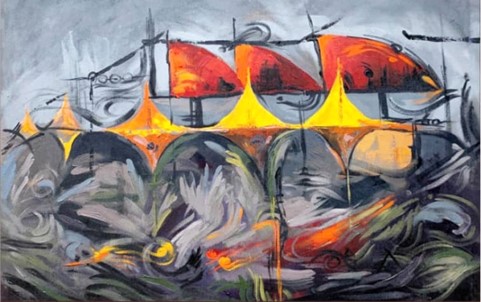
In my opinion, Dankyes’ exhibition is a visual narrative that traverses the emotive scenes of those affected by the fire. The works on display depict the collective memory of the Jos main market, portraying the myriad emotions, struggles, and resilience of the people who once thrived there. Sellers and buyers have adapted to the reality and commercial activities are on in Jos main market. For instance, in the painting titled Adaptability and the People, the artist depicted how the market’s traders have adapted to their new reality and continue with their commercial activities. This painting is evidence to human ingenuity and the ability to find creative solutions in the face of adversity. The vibrant colors and dynamic composition highlight the resilience and determination of the community. Indeed, the people have adapted to the market as it currently stands, as people are seen to be moving, doing several activities in the painting. See figure 1 for Adaptability and the People.
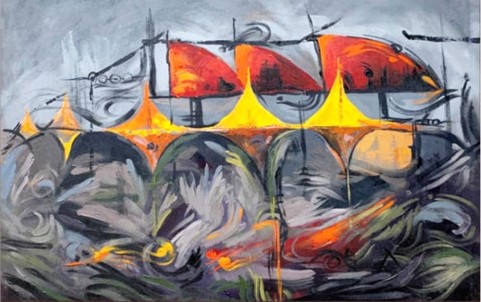
Figure 1, Dankyes Ephraim, Adaptability and the People, Acrylic on Canvas, 87×102 cm.2021
The historical context of the Jos main market is important to understanding the full impact of its loss. As one of the largest markets in West Africa, it was not merely a place of trade but a symbol of economic and social interconnection. The fire’s destruction extended further than the physical destruction, disrupting the lives of thousands who depended on the market for their livelihoods. Dankyes’ paintings serve as both a memorial and a celebration of this iconic space, honoring its legacy while acknowledging the profound changes it underwent, as well as giving the visual narrative of the market to people who have no idea what the market looked like. Overall, Delineating the Jos Burnt Market is more than an art exhibition; it is a narrative of resilience and hope. Through these works displayed, Dankyes invites viewers to engage with the history, emotions, and enduring spirit of a community rebuilding itself from the ashes. The exhibition stands as a tribute to the Jos main market and its people, a reminder of the power of art to heal, inspire, and transform in the face of unimaginable loss.