Kartyo Charity Terumbur
Introduction
Generally, style in art has been the attribute that distinguishes an artist, a group of artists, a movement, a school, or a group of people. Sporre (2006) states that “style is tantamount to the personality of an artwork: the body of characteristics that identifies an artwork with an individual, a historic period, a ‘school’ of artists, or a nation. ” Getlein (2002) defines style as a product of constant, recurring, or coherent visual or conceptual traits, while Lazzari and Schlesier (2005), on their part, see style as the manner of expression that is characteristic of art, either made by an individual artist or from a historic period or an entire civilization. The above definitions, indeed articulated in one way or another, constitute style. However, this paper sees Sporre and Getlein’s definitions of style as conceptually aligning with the author’s thoughts and therefore informs the perception of style as discussed in this paper.
It is within this context that this paper seeks to study the individual styles of selected painters of the Zaria Art School, with the aim of correlating, or otherwise of style in the paintings of artists of the Zaria Art School vis-a-vis the school’s acknowledged freedom of expression by varied authors. The paper will be focused on paintings of the Ph.D. graduates of the Zaria Art School, who graduated between 2014 and 2020, while the methodology used will be by describing the constant basic elements of design in line with the principles of design in each artist’s work, as stated by D’Alleva (2013) and Cornow (2018). Both authors allude that in studying style, the visible attributes, as well as the principles of design in the artwork, should be considered. This paper is therefore structured in a way that gives a brief background of the Ph.D programme of the Zaria Art School and a general discourse on the individual painting styles of artists. Subsequently, the paper will focus on the Ph.D scholar artists of the Zaria Art School and their paintings and conclusions drawn thereafter from the objective discourse of their works.
Background
The Zaria Art School has produced myriads of artists since its inception, graduating with a Bachelor of Arts Degree (B.A.), Master of Fine Art (M.F.A.) in Painting and Sculpture, as well as Doctor of Philosophy in Painting and Sculpture. The study will therefore, be focused on paintings of the Ph.D students in painting only, who graduated between 2014 and 2020. This is because the Ph.D programme is assumed to be based on a specific philosophical basis, which are unique to each researcher and therefore influences the style used to express them. Between 2014 and 2020, the Ph.D programme has graduated a total number of fourteen (14) students with Doctors of philosophy in Painting between 2014, when the first set of students graduated, and 2020. Each student produced a certain number of paintings, exploring their individual styles. This paper sampled eleven (11) students, out of the fourteen (14) graduates; however, only 3 of the students are discussed, and all paintings discussed are products of the students’ studio-based research for the Ph.D. programme. For this paper, one painting from each of the 3 students will be discussed.
Selected Artists of the Zaria Art School
SANI, Mu’azu Mohammed (b. 1959) After his basic education, he proceeded to Ahmadu Bello University, Zaria, where he obtained the following degrees; A Bachelor of Arts Degree in 1983, specializing in painting, and a Master of Fine Art (MFA) in Painting in 1986. Sani was one of the first students admitted by the Zaria Art School in the 2009/2010 academic session for the Ph.D in Painting degree, and he graduated in 2014. Sani is a painter who is generally known for his splashing technique, resulting in paintings that are stylistically pointillist; however, the works produced during his studio practice for the Ph.D research titled “Swange Dance Steps as Vehicle for Contemporary Expression in Painting.” one of his paintings is “DP3 (Development Painting 3)” in plate I.
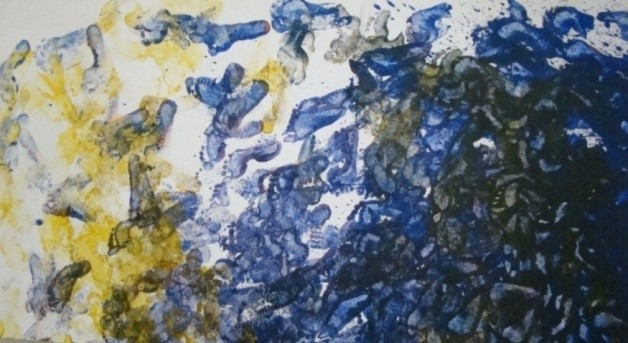
Plate: I: “DP3 (Painting 3)”, Sani Mu’azu Acrylic on Canvas, 122 cm x 244 cm, 2012, Artist’s Collection.
“DP3 (Painting 3)” is a composition of multiple colored footprints on a white background. The artist’s composition depicts repeated yellow footprints in the right foreground, which become faint as they recede into the background. At the left side of the painting are smeared blue and black footprints, which seem to begin from the left side, moving towards the right side of the painting, where they become faint. The arrangement of the black and blue footprints, which dominates the left side of the painting, gives it an asymmetrical balance. “DP3 (Painting 3)”is the third unit of Sani’s thirteen-panel painting. Its foreground benefits from blue and yellow palettes at the left side of the painting. The dominance of blue footprints in the painting seems to suggest that, the dancers approached the canvas from the blue palette. The multiple layers and overlapping of the blue and black footprints on the right side of the painting appears to create a composition of silhouette figures engaged in vigorous dance steps.
Sani employs unconventional media, the ‘feet’ as his brush and large canvas surfaces, some of which serve as palette and finished paintings. His paintings are therefore a result of swange dance expressions, which stylistically have illusionistic forms, blurred colours and a mixture of calm, cool or tensed effects depending on the palettes that had the most impact on the panel. Sani’s style of painting can thus be referred to as action painting, a painting style that falls under the Abstract Expressionist movement, which is characterized by innovative brushwork, as well as, nonrepresentational subject matter
AKPRARA, Amos Osakor (b. 1968) obtained a National Certificate in Education (N.C.E) in 1993, from Federal College of Education, Katsina. He then proceeded to Ahmadu Bello University, Zaria, where he obtained a Bachelor of Arts Degree in Fine Arts, in 1998 and a Master of Fine Art (MFA), in Painting in 2002. He is also one of the first set of Ph.D in painting students, who gained admission in the 2009/2010 academic session and graduated in 2015. His Ph.D research titled “Perception and Visual Interpretation of Banana Plant Imagery in Painting” sort to compose painterly images that can be deduced when viewing the banana plant, as well as, using such images to evoke socio-political, cultural, and economic issues within the environment. One of his paintings is “The Cracked Pseudo-Stem” in plate II.
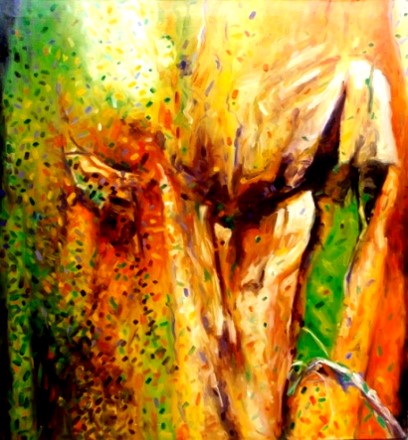
Plate II, “The Cracked Pseudo-Stem”, Akprara Amos Osakor, Oil on Canvas, 77 cm x 89 cm, 2011 Artists Collection
“The Cracked Pseudo-Stem” is also a painting by Akprara. The painting depicts a large banana pseudo-stem, with a leaf sheath peeling off at the left side of the painting. Akprara’s painting has little negative space, as the stem seems to cover most parts of the canvas, with little space between the trunk and the left end of the canvas and between the trunk and the leaf sheath. The stem is depicted in varied shades of brown, while the background of the painting is depicted green. The depressions on the stem and the peeled leaf seem to create the look of a dog’s eyes, which are closed, Nose Bridge and ear. The painting is characterized by varied colours of short brushstrokes. The artist is not particular about the theme of the painting, but the expression of the imagery formed by cracks on the pseudo-stem of the banana plant.
The basic features of Akprara’s style of expression are his subject matters, which are drawn from the nature and structure of the banana tree. His paintings are characterized by conceived images from the structure of the banana plant, as well as, the use of short and fur-like lines in his paintings. There is also a deliberate attempt to maintain the banana plant’s natural colours, which exhibit some pointillist tendencies sometimes. His style of expression, which depicts subjective images of the banana plant other than objective ones and sometimes strong brushstrokes, can be categorised under the Expressionist movement.
ADIWU, Talatu Onkala (b. 1982) After her basic education, Adiwu obtained a Bachelor of Arts Degree in 2006 from Ahmadu Bello University Zaria, specializing in painting. Her Master of Fine Art (MFA) in Painting and Doctor of Philosophy (Ph.D) in Painting are also obtained from Ahmadu Bello University, Zaria in 2011 and 2016 respectively. Born in 1982, Adiwu hails from Bassa Local Government Area of Plateau State. Her Ph.D titled “A Systematic Analytical Exploration and Adaptation of the Spider Form in Painting” was inspired by spiders. Adiwu finds aesthetics from the patterns within the spider, its web, and cobweb for her expressions. An example of her painting is “Stiff Cadaver” in plate III.
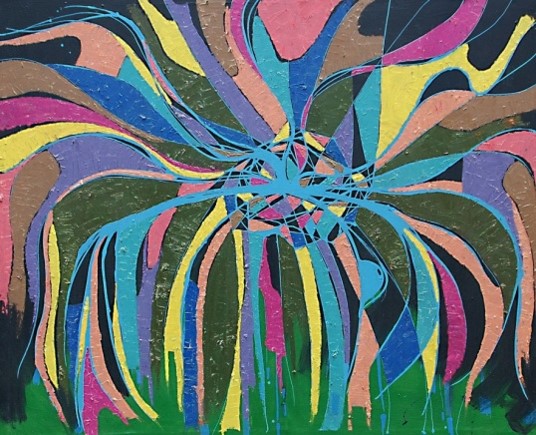
Plate III: “Stiff Cadaver”, Adiwu Talatu, Oil on Canvas, 152.4 X 91.44 CMArtist’s Collection
“Stiff Cadaver” is an abstract composition of colours, shapes, and lines. The painting begins around the center of the canvas, where the artist uses a light shade of blue in form of a spill, spreading through the painting. Adiwu further breaks her space into varied sizes and coloured shapes, the small ones at the center, followed by bigger ones, which are interspersed throughout the painting. The foreground of the painting is painted green, with dark blue at the top, left and right sides of the painting. Adiwu’s arrangement and use of dark blue at the center of the painting create an illusion of depth. The total arrangement of shapes in the painting gives it a symmetric balance. The painting is inspired by two dead spiders, which the artist saw hanging at the corner of a building; Hence, the title of the painting.
The basic features of Adiwu’s style of expression includes diverse lines, breaking her canvas using coloured shapes, that are painted with subdued, as well as, vibrant colours; The works are mostly with no representational forms, and no visible brush strokes, yet, her manipulation of lines, colours, and shapes captures the essense of her subject matter (spiders and webs). Her style of expression can be said to be, a combination of abstract expressionism and Cubism.
Conclusion
This paper has examined the individual painting styles of three selected Ph.D. graduates at the Zaria Art School through an analysis of their paintings. The study reveals that although the artists share a common academic background and are trained within the same institutional tradition, their artistic expressions are distinguished by unique stylistic tendencies shaped by their individual research interests, philosophical orientations, subject matter, and experimental approaches to painting. The analyses of the works of the selected artists, Sani Mu’azu Mohammed, Amos Osakor Akprara, and Talatu Onkala Adiwu demonstrate that each artist developed a distinctive visual language: while Sani employs action painting through unconventional tool and techniques inspired by Swange dance movements, Akprara derives expressive imagery from the structural forms of the banana plant, and Adiwu, on the other hand, explores abstract compositions inspired by spiders and their webs. These differences affirm that the Zaria Art School encourages artistic individuality rather than stylistic uniformity, allowing artists to develop peculiar styles of expression, as well as maintaining conceptual development.
The paper therefore, concludes that the Ph.D. programme of the Zaria Art School provides an environment that nurtures innovation, research-driven creativity, and stylistic diversity. Consequently, the selected scholar artists exemplify how advanced studio research contributes to the emergence of distinctive artistic styles and identities that enrich contemporary Nigerian painting and reinforce the Zaria Art School’s enduring legacy of liberal expression.
References
Curnow, K. (2018) The Bright Continent: African Art History. Retrieved from https://www.pressbooks.ulib.csu 20th December, 2021. 4:35pm
D’Alleva (2003) Introducing Art History: A Guide to Special Terms and Methods. In: The Visual Arts: A History. 6th edition. Prentice Hall Inc., Upper Saddle River, New Jersey. p. vii
Getlein, M. (2002) Gilbert’s Living with Art. 6th Edition. McGraw-Hill Companies, Inc. New York.
Lazzari, M. and Schlesier, D. (2005) Exploring Art: A Global, Thematic Approach. 3rd edition.Thompson Higher Education, USA.
Sporre, D. (2009) Reality through the Arts. Sixth Edition. Pearson Education- Inc., Upper Saddle River New Jersey. p 30
Just as mentioned,art styles are what make an artist different,it is also a way to valuate an artist’s creativity and level of deep thoughts,it also intriguing as to how the Zaria art school gives room for freedom of expression…
The Zaria freedom of expression has helped its graduates to develop a unique identity in their artistic explorations