Faida Samuel
Introduction
Most artists over the years have often relied on memory and perception as powerful sources of inspiration, using them to shape visual stories that speak to both personal and collective experiences. Memory allows artists to revisit moments from the past, while perception helps them interpret and reimagine these moments in new and expressive ways. As such, artworks become containers of emotion, history, identity, and imagination, thus, many contemporary artists draw from this relationship between what they remember and how they see the world, creating forms that reflect inner truths as well as, shared cultural realities. Therefore, Mustapha Garba Nadama is not in isolation when it comes to that. His practice shows that he is not isolated from the broader experiences that shape artists globally; like many others, his creativity is deeply connected to the memories he holds and the perceptions he forms about his environment. Nadama transforms recollections, both personal and communal, into visual expressions that carry emotional depth and symbolic inclinations. His use of brushstrokes, colours choices, textures, recurring motifs as well as, themes of the paintings reveal how memories become active forces in shaping his perception of the world. In Nadama’s artworks, memory is not a fixed or perfect record. Instead, it shifts and expands, merging with the artist’s perception to create layered visual narratives that invite viewers to reflect on their own emotional responses. His compositions often stand as bridges between lived experience and imagined possibility, making his paintings spaces where internal and external worlds interact. Nadama’s engagement with memory and perception highlights how artists reinterpret the past in order to understand the present, and how the act of seeing is shaped by what one remembers. This paper explores how Mustapha Garba Nadama uses memory and perception as central elements in his creative process. By examining his themes, symbols, and stylistic choices, the paper aims to reveal the deeper cultural and historical dimension of emotional, his work. Consequently, the paper looked at, memories and perceptions in painting exploration, memories and perceptions in Nadama’s paintings and a conclusion.
Memories And Perceptions in Mustapha Garba Nadama’s Paintings
Nadama has created a large body of paintings that explores the themes of memory and perception, with his paintings often grouped into distinct series. One of the series is Memories, which draws inspiration from his childhood experiences in Gusau during the early 1970s and late 1980s. These paintings serve as a visual diary of his past. According to the artist, “In the 1970s and late 80s, most homes were traditional mud houses clustered closely together, with only a few made of cement. This environment, rich with the earthy aesthetics of classical Northern Nigerian architecture, remains a lasting influence on my visual language.” Some of Nadama’s work reflects the beauty and simplicity of this architectural style, with its natural materials. The artist further states that, his early experiences in Makarantar Allo, a traditional school where children learned from a Malam (teacher), are also pivotal to his creative expression. These experiences, he says, form a foundation for much of his work. “Makaranta,” is a recurring theme in his paintings’ memory series, representing both a physical place and a spiritual journey.
Through Makaranta themes, Nadama recalls the sense of community, discipline, and knowledge that these schools instilled in him and the other children. His memories of these formative years are captured in works that explore the rhythms of everyday life and the teachings that shaped his understanding of the world. Consequently, through his paintings, Nadama revisits significant moments from his childhood, including his first journey from Gusau to Sokoto, among many other formative memories. Each of these memories is reimagined on canvas, becoming a means of preserving not only personal history but also a broader cultural narrative that continues to influence his creative identity. In the Memories series, Nadama invites the viewer into his world, where personal history and cultural heritage are depicted. Examples of his works in the series of memories include Marinna, Amanawa, Makaranta Malam Labaran, and Makaranta Malam Nasiru, just to mention a few among several others. See plate i as an example of work in this series titled; Makaranta Malam Nasiru.
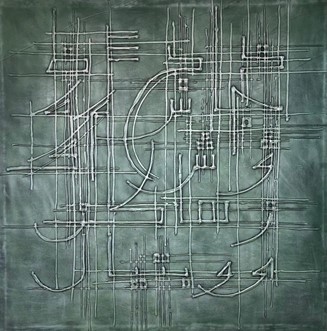
Plate i, Makaranta Malam Nasiru, Mustapha Garba Nadama, Acrylic on Canvas
The painting in plate i is an abstract composition in which the artist employs a variety of curving, vertical, horizontal, thick, and thin lines. These linear elements intersect and overlap, creating diverse shapes and giving the composition a textural feel. The forms resemble Arabic letters written in old Ajami script, giving the work a calligraphic presence. In Makaranta Malam Nasiru, the artist attempts to visually capture his early memories of attending his first Islamiya school in Gusau at the age of five or six. Islamiya refers to Islamic schools where young Muslim children receive foundational religious education. For the artist, Nadama, his earliest Islamiya experience was under the tutelage of Malam Nasiru, hence, the titled Makaranta Malam Nasiru
Makaranta Malam Nasiru serves as a reminder to Nadama, an attempt by him to retrieve and translate an early childhood experience into visual form of painting. By using Arabic alphabet in old texts ajami, the artist depicts the painting in the environment of Islamiya education, where the repetition of letters, recitation, and writing formed the core of early learning. These calligraphic fragments operate like reminder traces and visual resonances of lessons once learned in Malam Nasiru’s classroom. The rough texture created by the layered lines may symbolize the sensory atmosphere of the Islamiya school, the murmur of recitations, and the structured yet informal learning space. Memory here is not polished or fully resolved instead, it retains the rawness and immediacy of a child’s perspective.
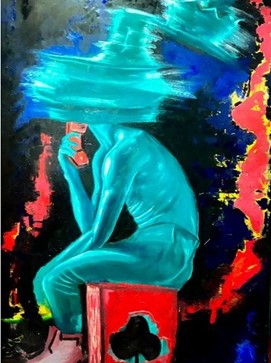
For perception series, it comprises works rooted in critical reflection on contemporary life, personal experiences of the artist, and existential concerns. According to the artist, “the painting in this series channel my internal responses to societal complexities and individual struggles. These works are driven by introspection and perceptual insight, inviting viewers to engage with the emotional and philosophical undercurrents that inform my artistic journey”. The artist further notes that, for example, the work titled “Sarke Sarke II” confronts the layered and often troubling realities of living in Nigeria today, highlighting themes of tension, survival, and social navigation”. Other examples of works in this series include, Barth Road and Zamani see plate ii for an example of the painting titled Zamani
“Zamani” meditates on the transient nature of human existence, how time shapes, erodes, and redefines our experiences, Is about transitory nature of life how time slips away and one moves from prominence to obscurity from strength to weakness from life to death
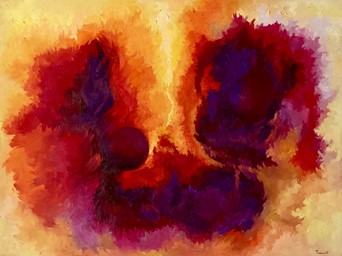
Plate ii, Zamani, Mustapha Garba Nadama, Acrylic on Canvas
Conclusion
The Memories series, with its rich narrative layers, not only reflects the artist’s personal experiences but also serves as a tribute to the collective memories of a generation growing up in Northern Nigeria during a period of significant social and cultural change. Nadama’s paintings stand as a bridge between past and present, inviting viewers to reflect on their own histories and the ways in which memories shape who we are.Through the Memories series, Nadama not only preserves his own memories but also creates a visual record of the traditions, architecture, and education that shaped Northern Nigerian society in the 20th century. His work is a celebration of the personal and the collective, and it continues to resonate with audiences who can relate to the universal themes of memory, growth, and identity.
References
Rowland, S. (2020) Art and Memory. Retrieved from https://www.artpistol.co.uk/art-and-memory, on November 30, 2025