Introduction
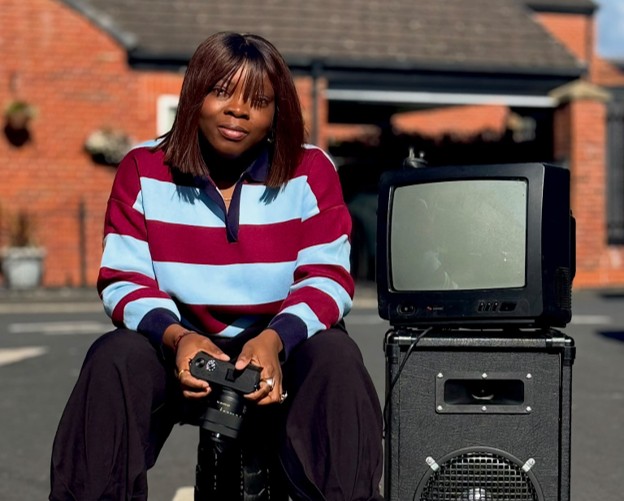
Tega Gbenedio is a Nigerian visual artist currently based in the United Kingdom whose practice spans photography, moving image, sound and installation. Her work focused on memory, belonging and the emotional bond people develop with everyday places in life. In her artistic exploration, she is drawn to things like: streets, buildings, vehicles, signs, clothing, passing figures and familiar sounds. Thus, through these, she thinks about how ordinary experiences become memories and how moving from one place to another can shape how we see ourselves and where we have come from. Memory plays an important role in her art. Her works raises questions about how certain things can be and the meaning attached to them through photography. The use of sound and moving image extends this exploration, showing how sound can unsettle the apparent certainty of a still image and change the way we experience a place.
KAD: You began your relationship with art long before you pursued it as a practice. Can you tell us where it all started?
Tega Gbenedio: My first exposure to art was at a young age, inspired by my uncle, who was a great photographer and he inspired me a lot. His creativity inspired my love of drawing and photography. Later on in life, I got into creative art at secondary school. For me, photography was a way to connect with my passion for me, which ultimately led me to moving-image, sound and installation. Now that I look back on it, I see that my habit of observation has always existed; I just didn’t realise it was an art practice.
KAD: Having grown up in Southern and Western Nigeria, how have these locations influenced your ability to capture memories, and how does this continue to shape your photographic work?
Tega Gbenedio: Growing up in Southern and Western Nigeria, in a world with a large number of places, people and ways of life, made me very observant from an early age. Everyday life was vivid and colourful, with colours, architecture and clothes, and people moving through different spaces. At the time, I didn’t think of this as an artistic practice; I just knew it to be so. I’m now seeing how much it has influenced my view and how I frame my works. This influence remains evident in my photography. I really like environments, and I like to be in them and appreciate the details of them. I learned from my childhood that a place’s essence is in the everyday experiences that people have.
KAD: You were formally trained as an accountant. What prompted your shift to art, and how has your professional background in accounting shaped your views on society through photography?
Tega Gbenedio: I chose to study accounting because it was more conventional and secured. but I liked art, even while I was studying accounting, my creative side never went away. When I got back into photography, it was still there. I don’t feel that accounting is tied to art, but what I have seen from my background has influenced my thinking. Accounting taught me to be detail-oriented, to see patterns in behaviour and to realise that, little pieces of information can have a very great impact. And photography works in a similar way. An image of a building, a person, a car or a street scene may seem insignificant on its own, but this information tells us something about society and the period in which we took that particular picture. And those little bits can tell us far more about life in general than the moments that we consciously seek to recall.
KAD: How did moving from Nigeria to the UK alter your perspective?
Tega Gbenedio: The move made me acutely aware of place. Leaving Nigeria created a distance that changed how I viewed both my homeland and my new surroundings. Aspects of my past that I had never considered took on new significance once they were no longer part of my daily life. In the UK, I also began to notice those unexpected moments of familiarity; a certain building, a colour, an old shopfront or the atmosphere of a street could evoke memories from my past. This was the first time I realised how memories can intertwine two distinct places, even if they are far apart. You can be present in one location yet see or hear something that transports you elsewhere.
KAD: Why do small places and objects play a pivotal role in your work?
Tega Gbenedio: Ordinary things have meaning even if they may not look important at first glance. I am interested in the things that people often ignore: our everyday things, traffic, shops, cars and clothes. I think they can be insignificant at the moment, but they do have meaning over time. Photography is what I need to concentrate on. I’m curious to see what happens when something routine is portrayed in a different way.
KAD: Memory and nostalgia are key themes in your work. How do you perceive their relationship?
Tega Gbenedio: I’m drawn to memory because I believe it is inherently unreliable. Sometimes, we remember places as being more vibrant, colourful or joyful than they truly were. In those moments, we’re not just recalling a location; we’re remembering who we were when we were there. I approach nostalgia with caution. I don’t want my work to imply that the past was necessarily better; instead, I’m curious about why we sometimes feel that way. Photography adds another layer of intrigue; a photograph captures something that once physically existed, but it can’t convey exactly how that moment felt. While the image remains unchanged, the meaning we attach to it can shift over time.
KAD: Your practice spans photography, moving image, sound and installation. What does each medium allow you to explore?
Tega Gbenedio: I generally start with an idea or emotion and then decide which is the right medium for it. Photography allows me to freeze a moment in time. The moving image captures time and movement, showing how people interact with their surroundings. Sound is different; it doesn’t need a visual element to evoke memories. Traffic, television, music or conversations can instantly transport us to another place. Installation allows me to get all these factors together to make a physical experience of the work. I find, however, that sound more than images, can evoke a different set of associations.
KAD: You’re interested in memories of places that individuals may never have personally experienced. How did this concept originate?
Tega Gbenedio: I started to wonder how migrants in migrant families hear things about their home before they’ve even visited it. Parents and grandparents describe home, their interactions with its people, food, expressions and events. This storytelling helps the younger generation to relate to that place. Is it true that you can feel a sense of familiarity with a place you’ve never visited? Can you have nostalgia for things you’ve never seen? I don’t have all the answers, but that uncertainty provides fertile ground for exploration.
KAD: Your work starts from personal experience. How much room do you leave for the audience’s own memories?
Tega Gbenedio: A great deal. While my experiences may serve as a starting point, I don’t want them to dictate how others perceive the work. Something that resonates with me because it reminds me of Nigeria may evoke entirely different memories for someone else. That’s crucial to me. I want the audience to infuse their own experiences into the work. If an image or sound prompts someone to recall their grandmother’s house, their childhood street or a long-forgotten memory, then the work has fostered a connection beyond my own.
KAD: Now that you have an artistic practice in the UK, how do you hope to further develop it?
Tega Gbenedio: I want to be a part of the artistic ecosystem in this city, and the work continues to develop through exhibitions with other artists and curators, as well as audiences. The way I interpret place and memory in the UK has already changed the way I think of them, and that’s very much how I want to conduct my practice next. I want to create larger installations that involve photography, moving-image and sound and display my work in spaces where people can see that it is there for them. I also want to make connections between my experiences in Nigeria and the UK without treating them as completely separate realities. My work in the UK is about more than showing work; I want to have a wider cultural conversation, collaborate, experiment and allow those experiences to lead my practice in new directions.